
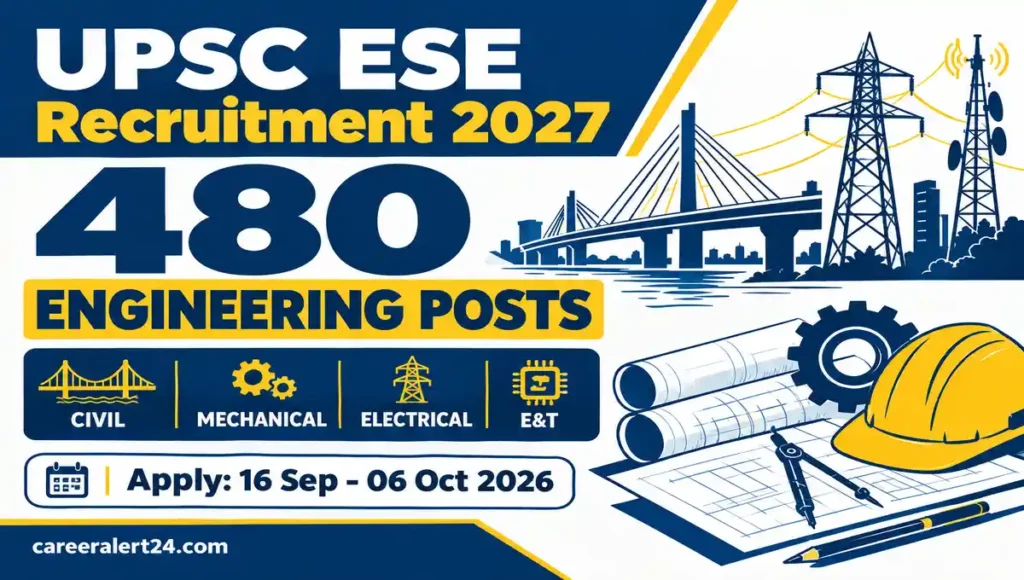
The Union Public Service Commission (UPSC) has announced the Engineering Services Examination (ESE) 2027 for recruitment to engineering services and posts under the Government of India. The examination covers four engineering disciplines: Civil, Mechanical, Electrical, and Electronics & Telecommunication. Around 480 vacancies are expected, including 19 posts for Persons with Benchmark Disabilities (PwBD), although the vacancy figure may be revised. Applications are open from 16 September to 6 October 2026.
Before Applying: Three Things Engineers Should Check
ESE 2027 is not a general graduate-level recruitment. The engineering discipline selected by a candidate affects the papers they will take and the services/posts for which they can be considered.
Before submitting the application, candidates should therefore verify:
- Their engineering qualification matches one of the four ESE disciplines or another qualification specifically accepted under the rules.
- They satisfy the 21 to 30 years age condition as on 1 January 2027, after considering any applicable relaxation.
- They understand that selection involves Preliminary Examination, Main Examination and Personality Test/Interview, with marks from all three stages contributing to the final merit.
The official examination notice should be checked carefully for qualification-specific and service-specific conditions before final submission.
UPSC ESE 2027 Recruitment at a Glance
| Particular | Details |
|---|---|
| Conducting Body | Union Public Service Commission |
| Examination | Engineering Services Examination 2027 |
| Notice Number | 02/2027-ENGG |
| Expected Vacancies | Approximately 480, subject to change |
| PwBD Vacancies | 19 |
| Engineering Disciplines | Civil, Mechanical, Electrical, Electronics & Telecommunication |
| Application Mode | Online |
| Application Start | 16 September 2026 |
| Last Date | 6 October 2026 |
| Preliminary Exam | 31 January 2027 |
| Main Exam | 18 June 2027 |
| Selection | Preliminary, Main, Personality Test/Interview |
| Application Portal | UPSC Online |
Which Engineering Disciplines Are Covered?
ESE 2027 is organized around four engineering disciplines:
- Civil Engineering
- Mechanical Engineering
- Electrical Engineering
- Electronics & Telecommunication Engineering
Recruitment is made to various Group A and Group B engineering services and posts under different Central Government ministries and departments.
The services covered can include engineering positions connected with railways, central engineering organizations, water resources, telecommunications, defence, power and other government departments. The exact services available for a particular discipline should be checked in the service-wise details in the official ESE 2027 rules.
This means applicants should not look at the total vacancy figure alone. The discipline they choose is an important part of the application and examination strategy.
UPSC ESE 2027 Vacancy Details
The Commission has indicated approximately 480 vacancies for ESE 2027. The number is provisional and can be changed by the Government depending on the final requirements of the participating services.
A total of 19 vacancies are reserved for PwBD candidates. The PwBD allocation includes categories such as Locomotor Disability, Hard of Hearing, Low Vision, and Specific Learning Disability/Multiple Disabilities as specified in the applicable rules.
Since the vacancy figure can be altered, candidates should treat the current number as an expected figure rather than a guaranteed final intake.
UPSC ESE 2027 Eligibility Criteria
Educational Qualification
Candidates generally need an engineering degree or an accepted equivalent qualification in the relevant discipline.
The notification recognizes several qualification routes, including an engineering degree from a recognized Indian university or institution and certain specified professional examinations or foreign engineering qualifications.
For certain services, including specified Electronics-related posts, an M.Sc. or equivalent qualification with the prescribed specialization may also be accepted.
There is an important qualification-related issue involving certain professional institutions. Candidates holding qualifications from the Institution of Electronics and Telecommunication Engineers (India) or the Aeronautical Society of India should read the current ESE rules carefully because the notification refers to restrictions arising from court judgments.
Similarly, the eligibility position concerning certain Institution of Engineers (India) qualifications is subject to the position stated in the current notification.
Candidates who are appearing in or intend to appear for the qualifying examination may also be permitted to apply provisionally, subject to the conditions in the examination notice. If such candidates qualify further, they must provide the required proof of passing within the prescribed period.
Age Limit
For ESE 2027, candidates must have:
- Minimum age: 21 years
- Maximum age: 30 years
- Age calculated as on: 1 January 2027
In practical terms, candidates must have been born between 2 January 1997 and 1 January 2006, subject to applicable relaxation.
Age Relaxation
Age relaxation is available for eligible categories under the applicable Government rules. The supplied recruitment information specifies relaxations including:
| Category | Maximum Relaxation |
|---|---|
| SC/ST | Up to 5 years |
| OBC candidates eligible for reservation | Up to 3 years |
| Eligible PwBD candidates | Up to 10 years |
| Certain ex-servicemen and defence-related categories | As prescribed |
| Eligible Government servants in specified cases | As prescribed |
Candidates claiming relaxation should make sure they possess the required supporting certificates. Category selection in the application should also be made carefully because changes may not be permitted later.
Nationality
The examination rules permit eligible Indian citizens as well as certain other specified categories, such as subjects of Nepal or Bhutan and specified Tibetan refugees or persons of Indian origin, subject to the conditions and certificates prescribed in the rules.
Candidates falling outside the standard Indian citizenship category should therefore check the nationality provisions of the official notice before applying.
Medical and Physical Requirements
ESE recruitment is not completed simply by qualifying in the written examination.
Candidates who reach the final recommendation stage are required to undergo the prescribed medical examination. The relevant medical and physical requirements are specified in the ESE rules, and service allocation can depend on meeting those requirements.
This is particularly important for candidates considering services with specific functional or physical requirements. PwBD applicants should also examine the prescribed functional classification and physical requirements applicable to the relevant services.
Who Is This Recruitment Suitable For?
ESE 2027 is primarily relevant to engineering graduates who want to compete for technical engineering services under the Central Government.
The recruitment may be relevant to:
- Civil Engineering graduates
- Mechanical Engineering graduates
- Electrical Engineering graduates
- Electronics & Telecommunication Engineering graduates
- Candidates holding another qualification specifically accepted under the ESE rules
- Eligible candidates appearing in the qualifying examination, where the provisional admission provisions apply
A candidate should not decide eligibility solely from the degree name. The exact qualification and discipline requirements for the selected service should be matched with the official rules.
UPSC ESE 2027 Exam Pattern
The examination has three stages, and the structure makes ESE different from a single-paper recruitment examination.
Stage I: Preliminary Examination
The Preliminary Examination is objective type and carries a total of 500 marks.
| Paper | Subject | Duration | Marks |
|---|---|---|---|
| Paper I | General Studies and Engineering Aptitude | 2 hours | 200 |
| Paper II | Engineering discipline selected by the candidate | 3 hours | 300 |
| Total | 5 hours | 500 |
The engineering paper corresponds to the candidate’s selected discipline.
Candidates qualifying in Stage I move to the Main Examination. Marks obtained in the Preliminary Examination by candidates who qualify are also counted for the final merit.
Stage II: Main Examination
The Main Examination is conventional or written-answer based.
| Paper | Subject | Duration | Marks |
|---|---|---|---|
| Paper I | Selected Engineering Discipline | 3 hours | 300 |
| Paper II | Selected Engineering Discipline | 3 hours | 300 |
| Total | 6 hours | 600 |
The two papers are based on the same engineering discipline selected for the examination.
The conventional papers are to be answered in English, and the question papers are set in English.
Stage III: Personality Test/Interview
Candidates who qualify the Main Examination are called for the Personality Test/Interview.
The Personality Test carries 200 marks and has no minimum qualifying marks according to the supplied examination details.
The final merit is prepared using marks from the Preliminary Examination, Main Examination and Personality Test.
This makes the examination particularly important for candidates who are preparing only for the objective Preliminary stage. Clearing Stage I is not the end of the selection process because the Main Examination and Personality Test also contribute to the final result.
Negative Marking in ESE Preliminary Examination
Negative marking applies to the objective-type papers.
For an incorrect answer, one-third of the marks assigned to that question is deducted.
Giving more than one answer to a question is also treated as an incorrect answer and attracts the prescribed penalty.
An unanswered question does not attract a penalty.
Because the Preliminary Examination contains negative marking, candidates should not treat random guessing in the same way as a calculated attempt.
UPSC ESE 2027 Important Dates
| Event | Date |
|---|---|
| Notification | 16 September 2026 |
| Online Application Begins | 16 September 2026 |
| Last Date to Apply | 6 October 2026 |
| Preliminary Examination | 31 January 2027 |
| Main Examination | 18 June 2027 |
| Personality Test/Interview | To be notified later |
Candidates should not wait for a separate reminder about the application closing date. The current application deadline is 6 October 2026.
Application Fee
The application fee is ₹200 for candidates required to pay the examination fee.
Female candidates and candidates belonging to SC, ST and PwBD categories are exempt from the fee, subject to the conditions in the notification.
OBC and EWS candidates do not receive fee exemption merely because they belong to those categories and should check the fee provisions applicable to them.
The fee can be paid through the payment methods specified by UPSC, including online banking and eligible cards or UPI.
Documents to Keep Ready
Candidates should prepare the necessary information and documents before beginning the examination-specific application.
Important items can include:
- Matriculation or Class 10 certificate for date of birth
- Engineering qualification certificate
- Relevant mark sheets or qualification proof
- Category certificate, where applicable
- PwBD certificate, where applicable
- Documents supporting age relaxation, where applicable
- Photograph
- Signature
- Other certificates required under the candidate’s particular claim
Some documents are required at the application stage, while original documents may be checked later during the recruitment process.
Candidates applying provisionally on the basis of an examination they are yet to pass should pay particular attention to the deadline for submitting proof of the qualifying qualification.
How to Apply for UPSC ESE 2027
The application is submitted online through the UPSC application system.
- Open the UPSC online application portal.
- Complete the required account creation and Universal Registration process.
- Complete the Common Application Form where required.
- Select the ESE 2027 examination-specific application module.
- Enter personal, educational and other required details.
- Select the appropriate engineering discipline and examination centre as applicable.
- Upload the required photograph, live photograph and signature in the prescribed manner.
- Upload supporting documents where required.
- Pay the examination fee if applicable.
- Carefully review the completed application before submitting it.
- Submit the application before 6 October 2026.
- Save the submitted application and relevant registration details for future use.
Candidates should use a valid email address and mobile number because UPSC communication relating to the examination may be sent through the registered contact details.
The application should be checked carefully before final submission because corrections may be restricted after submission.
Details ESE Candidates Should Not Overlook
1. The engineering discipline matters
ESE is divided into four engineering disciplines. Selecting a discipline is therefore not simply an application-form preference. It determines the engineering papers candidates face.
2. The vacancy figure is not necessarily final
The current figure of approximately 480 vacancies is subject to alteration. Candidates should rely on the final vacancy information issued by the Commission rather than treating the initial figure as fixed.
3. Preliminary marks contribute to final merit
Stage I is not merely a qualifying screening test. Marks obtained by candidates who qualify for the Main Examination are counted in the final merit.
4. Main Examination preparation needs a different approach
The Main Examination is conventional and carries 600 marks. Candidates who prepare only for objective questions may need to change their preparation approach for descriptive engineering papers.
5. Qualification exceptions need careful checking
Candidates relying on professional examinations or non-standard engineering qualifications should read the qualification provisions carefully instead of assuming that every engineering-equivalent certificate is accepted.
6. Medical requirements remain relevant after the written stages
Candidates should review the medical and physical requirements applicable to the services they are considering.
Common Application and Preparation Mistakes
For ESE 2027, some avoidable mistakes can have a direct effect on a candidate’s application or preparation:
- Selecting an engineering discipline without first checking the qualification requirements.
- Assuming that every engineering-equivalent professional qualification is automatically accepted.
- Entering an incorrect date of birth or educational qualification.
- Claiming age relaxation without having the required supporting certificate.
- Treating the Preliminary Examination as the only stage that matters.
- Ignoring conventional-answer practice for the Main Examination.
- Guessing excessively in the objective papers despite the negative-marking provision.
- Failing to retain application and registration details after submission.
CareerAlert24 Insight
The most important feature of ESE 2027 is not simply the approximately 480 vacancies. It is the three-stage merit structure combined with discipline-specific engineering papers.
A candidate who qualifies in Civil Engineering, for example, is preparing for a very different technical examination from an Electrical or Mechanical candidate. At the same time, every candidate faces the common General Studies and Engineering Aptitude paper in the Preliminary stage.
There is also a major difference between clearing the Preliminary Examination and being competitive for final allocation. The Preliminary stage carries 500 marks, the Main Examination carries 600 marks, and the Personality Test adds another 200 marks. Therefore, preparation should be planned across the entire selection process rather than stopping after objective-test preparation.
Candidates should also distinguish between the number of vacancies announced initially and the final vacancies actually available for allocation. UPSC has stated that the approximate vacancy figure can be altered.
For candidates with an engineering degree who meet the age and other conditions, the first practical step is to confirm the exact discipline and service eligibility before completing the application.
How Candidates Can Prepare for ESE 2027
The preparation approach should match the three stages.
For the Preliminary Examination, candidates need to balance General Studies and Engineering Aptitude with their discipline-specific objective paper. Previous UPSC ESE papers can help candidates understand the style and level of questions.
The Main Examination requires additional practice because answers are written conventionally. Candidates should therefore work on presenting technical solutions clearly within the available time.
A practical preparation sequence is:
- Confirm the syllabus for the selected engineering discipline.
- Strengthen core engineering concepts.
- Solve previous ESE question papers.
- Practise objective questions under time limits.
- Track mistakes caused by guessing because of negative marking.
- Begin conventional-answer practice before the Preliminary result.
- Continue revision across both technical and common subjects.
UPSC publishes previous ESE question papers, including discipline-wise papers, through its official website.
Frequently Asked Questions
Can a final-year engineering student apply for ESE 2027?
Candidates who have appeared for or intend to appear for the qualifying examination may be permitted to apply provisionally, subject to the conditions in the official notification. They must subsequently provide proof of qualification within the prescribed timeline.
What is the age limit for UPSC ESE 2027?
The normal age requirement is 21 to 30 years as on 1 January 2027. Eligible candidates can receive relaxation according to the applicable rules.
How many vacancies are available in ESE 2027?
Approximately 480 vacancies are expected, including 19 vacancies for PwBD candidates. The number is provisional and may be changed.
Which engineering branches can appear for ESE 2027?
The examination covers Civil Engineering, Mechanical Engineering, Electrical Engineering, and Electronics & Telecommunication Engineering, subject to the qualification rules.
Is there negative marking in ESE Preliminary Examination?
Yes. An incorrect answer in the objective papers attracts a penalty of one-third of the marks assigned to that question.
Does the Preliminary Examination count toward final merit?
Yes. For candidates who qualify Stage I, the marks obtained in the Preliminary Examination are counted along with the Main Examination and Personality Test marks for final merit.
How many stages are there in ESE 2027?
There are three stages: Preliminary Examination, Main Examination and Personality Test/Interview.
Is there a medical examination?
Yes. Candidates finally recommended by UPSC are required to undergo the prescribed medical examination and must meet the applicable physical and medical requirements for service allocation.
Important Links
| Purpose | Link |
|---|---|
| Apply Online | UPSC Online Application Portal |
| Official Notification | UPSC ESE 2027 Notification PDF |
| Official Website | UPSC Official Website |
| CareerAlert24 WhatsApp Channel | CareerAlert24 WhatsApp Channel |
| CareerAlert24 Telegram Channel | CareerAlert24 Telegram Channel |
Conclusion
UPSC ESE 2027 is a multi-stage engineering recruitment covering Civil, Mechanical, Electrical and Electronics & Telecommunication disciplines, with approximately 480 vacancies currently indicated. Candidates should first verify their engineering qualification, age and applicable category conditions, then select the correct discipline and complete the online application before 6 October 2026.
Because vacancy numbers and other recruitment details can change, applicants should always verify the latest official UPSC notification and subsequent notices before taking any final action.
